Amazon Kinesis Vs Amazon MSK
Comparing AWS's two managed streaming services on technology, use cases, operations and flexibility.
Amazon Kinesis and Amazon MSK (Managed Streaming for Apache Kafka) are both managed streaming services on AWS, but they differ in terms of technology, use cases, operational management, and flexibility. Here’s a breakdown of their key differences:
1. Core Technology
- Amazon Kinesis: A fully managed, proprietary AWS streaming service designed for real-time data ingestion and processing. Kinesis includes several sub-services like:
- Kinesis Data Streams: For real-time data streaming.
- Kinesis Data Firehose: For batch or near-real-time data delivery to storage like S3 or Redshift.
- Kinesis Data Analytics: For real-time SQL-based analytics on data streams.
- Amazon MSK (Managed Streaming for Apache Kafka): A managed version of Apache Kafka, an open-source distributed event streaming platform. MSK provides the same features and ecosystem as a Kafka deployment but is fully managed by AWS, offering seamless Kafka integration.
2. Integration and Ecosystem
- Kinesis: Tight integration with AWS services. It works well with other AWS products like Lambda, S3, DynamoDB, Redshift, and CloudWatch, offering out-of-the-box support for most AWS-native applications.
- MSK: Since MSK is based on Kafka, it integrates with the Kafka ecosystem, including Kafka clients, connectors, and consumer groups. MSK supports Kafka connectors through Kafka Connect for easily connecting to external systems and works with any Kafka-compatible tools (such as Apache Spark, Flink, and Debezium).
3. Operational Management and Ease of Use
- Kinesis: Requires less operational management as AWS handles scaling and provisioning. Kinesis Data Streams automatically partitions data and can scale dynamically based on load. With Kinesis, you don’t manage brokers, Zookeeper, or partitioning.
- MSK: Offers a managed Kafka cluster with automated setup and maintenance of Kafka brokers and Zookeeper. However, MSK requires knowledge of Kafka internals, including handling Kafka partitions, retention, and consumer group configurations. Scaling MSK clusters may require resizing or adding partitions manually.
4. Data Retention and Replay
- Kinesis: Kinesis Data Streams stores data for up to 365 days, but the default retention period is 24 hours (configurable up to 7 days for real-time streaming). Kinesis allows replaying data within the retention period by re-reading specific sequence numbers.
- MSK: Kafka topics in MSK retain data based on configurable settings (e.g., time-based or size-based retention) and allow indefinite retention as long as the storage limit isn’t reached. This makes MSK preferable when long-term event retention or complex replay capabilities are needed.
5. Latency and Throughput
- Kinesis: Offers low-latency data ingestion and is optimized for high-throughput applications, especially when combined with Kinesis Data Firehose for buffering before delivery to destinations.
- MSK: Kafka is known for low latency and high throughput, especially with larger workloads. MSK is suitable for applications that need very low-latency access to data and complex event ordering, as Kafka ensures strict ordering guarantees within partitions.
6. Cost
- Kinesis: Pricing is based on the number of shards, PUT payload units (data records per second), and any additional processing done (e.g., Firehose transformation). Costs scale with usage, and AWS automatically handles shard scaling within limits.
- MSK: Costs are based on broker instance type, storage usage, and any additional Kafka connectors or AWS integrations. MSK can be more cost-effective for high-throughput applications but may require careful sizing and scaling to optimize costs.
7. Use Cases
- Kinesis: Ideal for real-time data streaming, IoT, monitoring data, and AWS-centric architectures. Use cases include real-time analytics, log and event streaming, and integrating AWS services.
- MSK: Suited for large-scale data pipelines, event sourcing, and applications with existing Kafka ecosystems. Use cases include microservices communication, change data capture (CDC), and complex stream processing with consumer group management and ordered processing.
8. Performance and Scaling
- Kinesis: Scales by adding shards dynamically but has some throughput limits at the shard level. It’s more efficient for smaller real-time tasks without the need for fine-grained scaling management.
- MSK: Kafka’s partitioning model provides more granular control over scaling, though adding partitions can sometimes require rebalancing. MSK’s performance scales well for high-throughput workloads but demands a deeper understanding of Kafka’s partitioning and consumer group model.
Summary Table
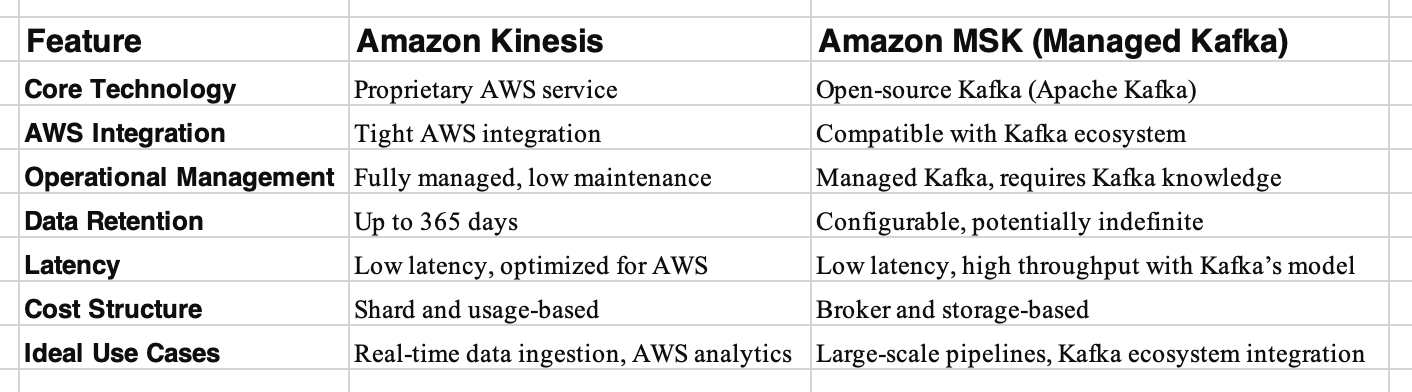
When to Use Each
- Use Kinesis if you need tight integration with AWS services, simpler operational management, and can work within AWS’s shard-based throughput limits.
- Use MSK if you need compatibility with Kafka, support for long-term data retention, or require high throughput with fine-grained control over partitions and consumer groups.
In summary, choose Kinesis for simpler AWS-native solutions, while MSK is better for Kafka-compatible ecosystems or more complex streaming requirements.
Originally published on LinkedIn. See the original post and its comments.